
Winston Ma: “It’s critical for young leaders to develop expertise in all three fields – finance, tech innovation, and government regulations”
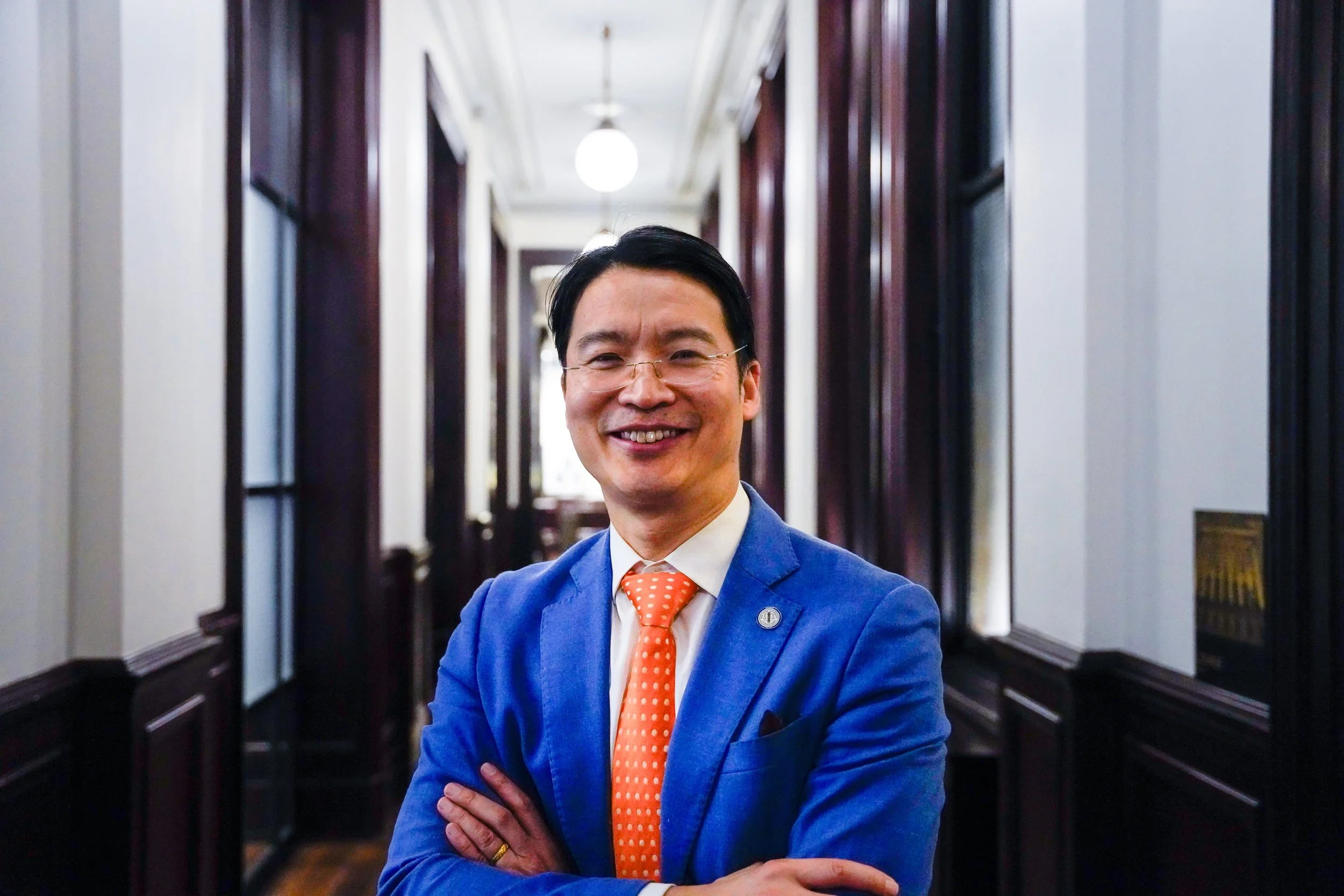
Interview with Winston Ma, CFA Esq. Executive Director of Global Public Investment Funds Forum and Adjunct Professor, NYU School of Law.
Government Tomorrow Forum: You define the new American economic strategy as State Capitalism with American Characteristics?
“The unique situation here is that the U.S. SWF is a SWF from a trade deficit country, driven by the executive power, not legislature”
Winston Ma: As I explained in my recent Opinion “Technological sovereignty with American characteristics” in the Financial Time, as well as in my corresponding Bloomberg TV interview, the new US Sovereign Wealth Fund (SWF) initiated by President Trump has already taken shape, and its investing into strategic sectors like AI and rare earth has reflected the industry policies of the Trump Administration.
To put this in the global context, the US is joining a powerful trend where SWFs – whether China or emerging economies – are the new, powerful tech investors, aggressively investing in AI and data technologies for both financial returns and strategic objectives.
For example, Gulf states have leveraged their oil wealth strategically with funds such as Abu Dhabi’s Mubadala investment fund and Riyadh’s Public Investment Fund (PIF), which aims to position the United Arab Emirates and Saudi Arabia, respectively, as a global AI hub. Not surprisingly, Trump’s US SWF is connected with the White House’s AI Work Plan recently released.
GTF: What makes the US SWF unique? Can other countries be inspired by it?
WM: The unique situation here is that the U.S. SWF is a SWF from a trade deficit country, driven by the executive power, not legislature. As such, the Trump administration is carving an alternative SWF path – one that is distinctly bottom-up, ad hoc and industrial strategy-driven, using sovereign capital not for national savings but as an instrument for strategic investments.
Can a country that runs persistent deficits really build one of the world’s biggest sovereign wealth funds? President Trump’s unconventional approach suggests yes. If successful, it could redefine the SWF model. This should inspire the emerging markets – even for those that do not have rich oil reserves like the Gulf nations – to creatively use the existing resources of their executive branch to set “strategic” SWFs for their strategic development goals.
GTF: What, in your opinion, makes the world so different today from what it was five or ten years ago? What is the biggest factor of change — COVID, Ukraine, Trump? Or a combination of those?
“The US SWF is joining a global trend of sovereign investment funds becoming new, powerful venture capitalists, actively scouting startups themselves, investing earlier, and even creating their own standalone VC arms”
WM: You may saw the combination of those, if you consider that fact that the supply chain security is a top concern for all governments globally, driven by the uncertainties out of global pandemic (Covid), military conflicts (Ukraine and more), and tariff war (Trump).
For example, the Trump administration’s $8.9 billion equity-for-grants deal with Intel was made against the backdrop that the US commerce secretary Howard Lutnick said late September that the administration’s aim is to “get chip manufacturing significantly onshored”. TSMC is the dominant player in chip manufacturing, especially advanced artificial intelligence chips, so Wall Street may advise Intel to focus on chip design instead. But Intel pulling out of manufacturing would be detrimental to the government’s efforts to shore up domestic chip making for reasons of supply-chain stability.
GTF: Will the new American SWF redefine the government investment strategies in the world and if yes, how?
WM: Yes. In addition to large ticket stakes in established tech firms like Intel, the US SWF under Trump Administration is enthusiastic about early investments into tech startups, too. Just in December 2025, the Trump administration announced a plan to take equity stake in the former Intel CEO’s Chip startup XLight, which in return would receive up to $150m to develop ultraprecise lasers for squeezing more circuits onto semiconductors. Most likely, the US government would even become xLight’s largest shareholder, according to the Wall Street Journal report.
The xLight investment shows that the US SWF is joining a global trend of sovereign investment funds becoming new, powerful venture capitalists, actively scouting startups themselves, investing earlier, and even creating their own standalone VC arms, such as Taiwania Capital, bankrolled by Taiwanʼs SWF.
“Globally, the SWF funds are emerging as the financier for the hard tech startups, whose technologies are vital to national competitiveness, but whose risk, scale and time dissuade private investment.”
The tech investments by government-backed SWFs are on par with private equity and venture capital funds, but often with a strategic objective on top of financial returns. That’s why they are especially suited for investing in high-risk, capital-intensive and long-horizon tech ventures, who often struggle to raise capital.
GTF: How do you think it will impact governments as such, i.e., public services, governance processes, etc., in America and beyond?
WM: That means the governments should play an active and significant role in its own innovation ecosystem of its domestic economy. In fact, in many areas the government will play the leading role to mobilize the domestic innovation ecosystem, because as shown in the US SWF case above, they may provide important capital to bridge the financing gap in the tech venture world.
Globally, the SWF funds are emerging as the financier for the hard tech startups, whose technologies are vital to national competitiveness, but whose risk, scale and time dissuade private investment. For example, as we speak, China just launched its “national venture capital guidance fund” at the end of 2025, as part of efforts to mobilize more patient capital for innovative and future industries. The fund is designed to pool hundreds of billions of yuan ($1 = 7 Chinese Yuan) in fiscal capital from local governments, financial institutions, state-owned and private enterprises, with the goal of mobilizing trillions of yuan in social investment.
Investment decisions will follow the principle of "investing early, investing small, investing long-term and investing in hard technology," the Chinese officials explained at the launch. However, the government will face challenges too: while the patient “guidance” capital will be the patient cornerstone capital to the short-termism in the private venture capital market, the government must also develop a framework to cover the transparency, benchmark, and accountability issues of such long-term investments.
GTF: What’s the new frontier to watch in the New Year of 2026? What would be your general advice to any young leader that joins the sphere of international governance today?
WM: Closely relating to the sovereign SWF funds is the sovereign digital currency, and in 2026 we may witness major leaps forward – and corresponding tensions. While the US is pushing US dollar stablecoins globally, China is expanding the reach of the e-Yuan, its CBDC (central bank digital currency).
Holdings of China's digital yuan, or e-CNY, will start generating interest income under a new framework set to take effect on January 1, 2026., as China, the only major economy that has tested a sovereign digital currency at large scale, steps up efforts to promote the use of its CBDC further. Globally, the central banks of UAE and China executed the first-ever cross-border payment using CBDC between the two countries in 2025, and more countries may join that CBDC network in the new year.
Therefore, it’s critical for young leaders to develop expertise in all three fields – finance, tech innovation, and government regulations, as we witness increasing activities at the intersection of SWF funds, tech investing, and global geopolitics.
Prof. Winston Ma, CFA & Esq., is an investor, attorney, author, and adjunct professor in the global AI-digital economy. He is a partner of Dragon Global, an AI-focused family office (CIO - Chief Investment Officer of the StorageBlue Capital Management), and he is also the Executive Director of Global Public Investment Funds Forum and an Adjunct Professor (on Sovereign Investors) at New York University (NYU) School of Law.
Most recently for 10 years, he was Managing Director and Head of North America Office for China Investment Corporation (CIC), China’s sovereign wealth fund. Prior to that, Mr. Ma served as the deputy head of equity capital markets at Barclays Capital, a vice president at J.P. Morgan investment banking, and a corporate lawyer at Davis Polk & Wardwell LLP. He is one of a small number of native Chinese who have worked as investment professionals and practicing capital markets attorneys in both the United States and China.
Formerly a nationally certified Software Programmer, Mr. Ma is the author of more than 10 books on SWF funds, digital economy, and global geopolitics, including The Hunt for Unicorns: How Sovereign Funds are Reshaping Investment in the Digital Economy and most recently “Blockchain and Web3” (among 2024 “six must-read blockchain books” by TechTarget). He has been frequently interviewed by CNBC and Bloomberg TV and quoted by major financial media including WSJ, Reuters, and Financial Times. He was selected a 2013 Young Global Leader at the World Economic Forum (WEF), and in 2014 he received the NYU Distinguished Alumni Award.